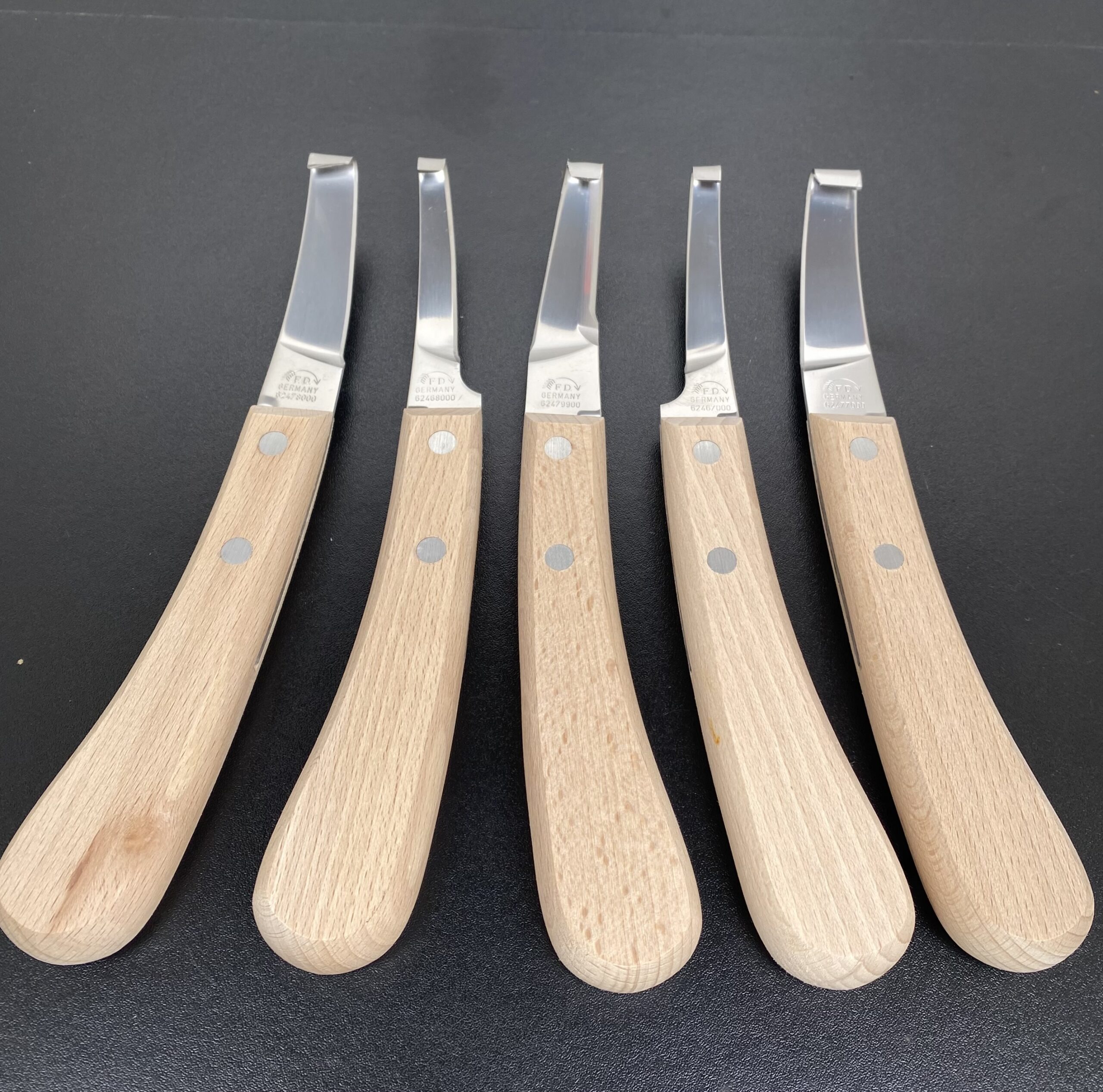
There is no single best hoof knife, and any honest buyer’s guide starts by saying so. The right blade is the one that fits your hand, suits the work you do most, and holds an edge with the upkeep you’ll realistically give it. What this guide does instead is lay out the choices that actually matter — blade profile, the major hoof knife brands compared side by side, steel and edge retention, and how a knife pairs with a sharpener — so you can match a knife to your crush rather than to a catalogue photo.
We trim cattle feet for a living, so this is the pro-to-pro version: where each option earns its place, and where the marketing outruns the metal.
Start with the blade profile, not the brand
Brand loyalty is worth less than picking the right shape for the job. Four choices cover most of it.
Left, right or double-sided
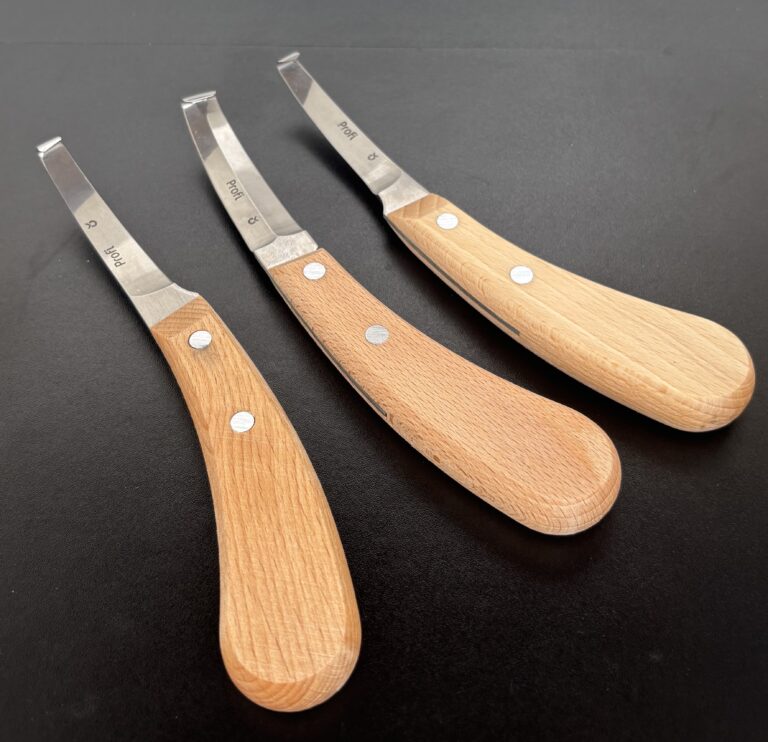
Hoof knives are ground with the cutting edge on the left, on the right, or on both sides. A single-edged knife cuts cleanly in one direction and is far easier to keep keen; most working trimmers carry a matched left-and-right pair so they can pare either claw without fighting the angle. A double-sided blade — like Profi’s short double-sided knife — is versatile and quick when you’re working at pace, but it’s less forgiving to sharpen and to handle safely. For a first knife, a blade ground for your dominant hand plus its opposite number will meet almost everything in the crush.
Narrow or wide
Blade width changes what a knife is good at. A wider blade shifts horn quickly and suits bulk paring of the sole and wall on routine trims. A narrower blade gives you more control for detail work — following a black mark in the white line, or dishing out around a lesion — without removing more horn than you mean to. Trimmers who do plenty of both often keep one of each rather than compromising with a single width.
Hooked and loop knives for searching
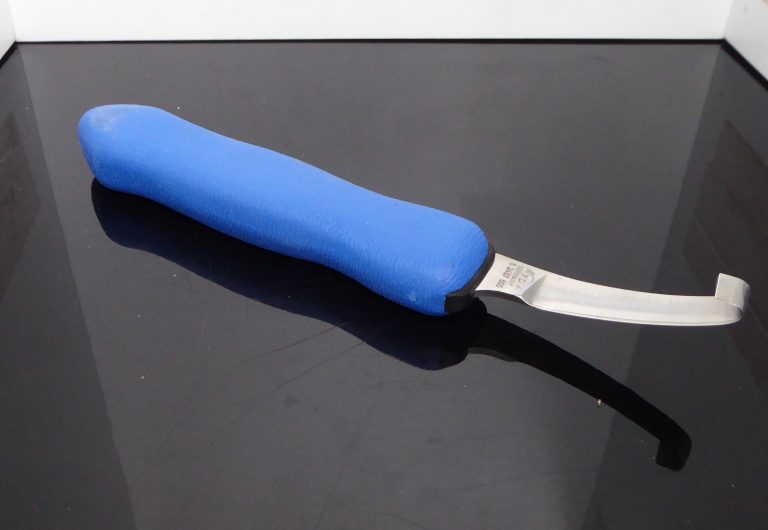
A hooked or loop knife — a blade curved into a closed loop, sometimes called a searching knife — is built for exploring rather than paring. The loop lets you open and follow a white line tract or drain an abscess with a controlled, shallow cut, instead of digging with the point of a paring knife. If abscess and white line work is a regular part of your day it earns its place in the roll; for routine foot trimming, a good paring knife and a sharp point will handle most of it. Hoofcare doesn’t currently list a dedicated loop knife, so for searching work reach for a narrower blade from the hoof knives range, or the probes and picks in the hoof trimming tools range, rather than assuming a loop knife is on the shelf.
The major hoof knife brands, compared
Hoofcare stocks four names, and between them they cover the patterns above. Here’s the fair version of each — respectful, not sales-sheet.
Dick
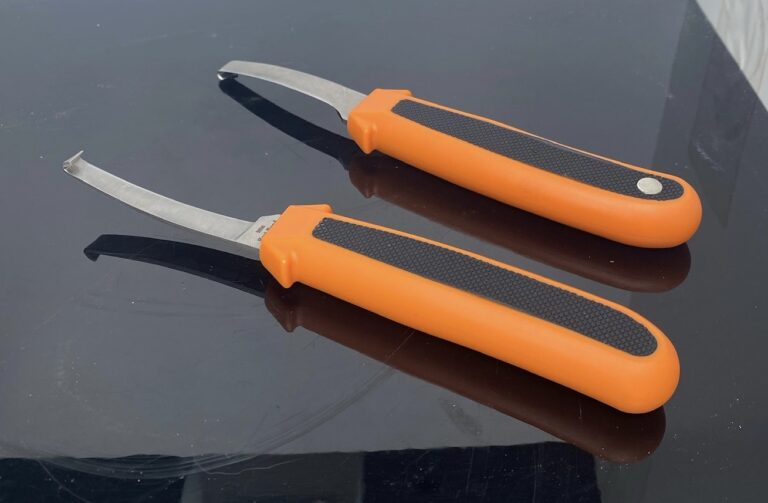
Dick is the blade most UK trimmers have owned at some point: the default professional knife, offered as a standard hoof knife and in an “expert grip” version with a fuller, more ergonomic handle for long days in the crush. If you want a knife you can walk into any yard with and not have to justify, this is it. It’s made in Germany by Friedr. Dick (F. Dick), a blade maker going back to 1778 — so the German-precision reputation is earned, not borrowed.
Aesculap
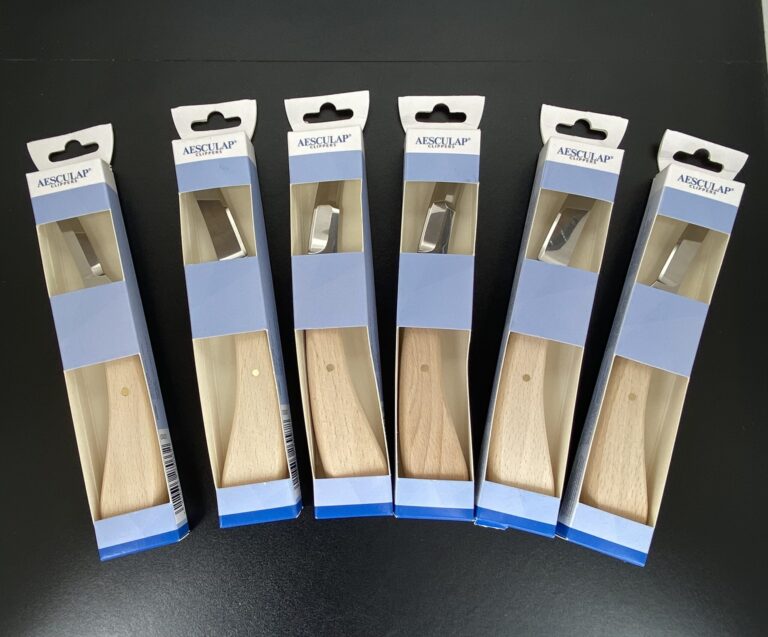
Aesculap sits in the same premium bracket — also German-made, from the Tuttlingen instrument maker that’s now part of the B. Braun group — with a hoof knife range and a Danish hard wood knife alongside it. That last one is a hoof-paring knife too, not a tool for shaping blocks: the “Danish hard wood” is the ergonomic thermally-treated hardwood handle, ground for fatigue-free work, rather than a different job. Trimmers who rate them tend to point to fit and finish over any single feature.
Profi
Profi is another German-made professional line, beech-handled, covering the standard hoof knife and the short double-sided pattern noted above — which makes it a sensible pick if you specifically want a compact double-edged blade for fast work.
Bovi-Bond
Bovi-Bond’s own knives come as a left-and-right pair and sit at the value end of the line-up — a straightforward working knife rather than a premium one. They also turn up bundled in the Bovi kit alongside the glue, which is a tidy way in for anyone building a foot-trimming kit from scratch.
Steel, edge retention and comfort
Strip off the badge and a hoof knife is steel and a handle, and the trade-offs are the same across every brand.
Steel and edge retention. The choice is keenness against upkeep. Harder carbon steel takes a very fine edge and hones back quickly, but it will rust in a wet, slurry-heavy job unless you dry it and wipe it with oil. Stainless resists corrosion and asks less of you day to day, but can take more work to bring to a true edge and may not hold it quite as long between touch-ups. Neither is “best” — it depends on how much maintenance time you’ll genuinely put in.
Comfort. Over a full session, handle shape matters as much as the edge — a knife that fights your grip tires your hand and makes the cut less accurate, which is why options like Dick’s expert-grip handle exist. Grip technique counts too: how you hold the knife governs both control and safety. See our guide on how to hold a hoof knife for the working method.
Pairing a knife with the right sharpener
A hoof knife is only as good as its last edge, so buy the sharpener at the same time as the blade — it’s not an afterthought. A fine stone (diamond or whetstone) sets and restores the edge, while a steel or strop is what you reach for to touch up between cows without a full re-grind. Match the stone to the steel you’ve bought: a harder carbon blade rewards a finer finishing stone. Our step-by-step on how to sharpen a hoof knife walks through the method, and you’ll find the stones, steels and strops to do it in the hoof knife sharpeners range.
Care and maintenance basics
A hoof knife is a sharpen-not-bin tool for most of its working life, and a little routine keeps it that way:
- Keep it keen between cows. A sharp knife is safer and does far less damage than a blunt one dragged through horn. A few passes on a steel or strop mid-session beats grinding a neglected edge back at the end of the day.
- Dry and oil after wet work. Carbon steel will spot with rust overnight if it’s put away damp and dirty; a wipe down and a smear of oil is all it takes.
- Store the edge protected. A blade rattling loose in a toolbox loses its edge and nicks the next thing it touches — keep it sheathed or in its slot.
- Replace only when it’s spent. Retire a knife once it’s been ground so far back that it’s lost its shape or won’t hold an edge — not before.
Our pick, by what you actually do
No single knife wins for everyone, so here’s how we’d choose by the job in front of you:
- Routine trimming, day in day out. A matched left-and-right single-edged pair from a premium range (Dick or Aesculap), with an expert-grip handle if you’re in the crush for hours — plus a sharpener to keep both keen between cows.
- Abscess and white line work. Add a narrower-bladed knife for controlled searching around a lesion rather than working the point of a wider paring knife too hard. (Hoofcare doesn’t currently list a dedicated loop knife — a narrow blade from the hoof knives range is the practical route.)
- Professional, high volume. Spend on a premium matched pair and a proper sharpening setup. Honing little and often between cows means you replace the steel itself rarely — the sharpener pays for the knife.
- Occasional — catching problems before the trimmer arrives. One good general-purpose knife ground for your dominant hand, plus a sharpener, covers most of what you’ll need. The Bovi-Bond left-and-right pair, or the Bovi kit if you’re also buying glue, is an economical way to start.
Choosing your next hoof knife
Browse the hoof knives range to see the Dick, Aesculap, Profi and Bovi-Bond patterns in one place, and pair whatever you choose with a stone or steel from the hoof knife sharpeners range so it stays keen from the first cow. For the rest of the crush, the hoof trimming tools range covers nippers, shears and the rest. Not sure which pattern suits your hand and your housing? Speak to the Hoofcare team for a steer.