The footbath is the cheapest herd-level lever most units have on lameness — and the one most often run on habit rather than a decision. Which footbath solution a dairy runs changes four things at once: what it costs to fill and refresh, how well it hardens skin and knocks back the bacterial load, how safe it is for the person mixing it, and what happens to the spent solution when it goes down the drain or into the slurry store. Get the choice right for your setup and the bath quietly does its job for years; get it wrong and you are either wasting money, exposing staff, or storing up a disposal problem.
This guide compares the main footbath actives — copper sulphate, formalin and zinc-based solutions — on cost, efficacy, safety and disposal, then works through how to choose for your herd. It assumes you already know what a footbath is for; if you want the basics of how footbathing fits into a herd-level plan, our guide to treating digital dermatitis covers the routine and the hygiene work that sits around the bath. Here we stay on the buyer’s question: which solution, and why.
Why the choice matters more than the label
No footbath cures active disease. Its job is to control transmission and keep clean feet clean — hardening skin and reducing the bacterial load passing through. Every one of the common actives does that to some degree, which is exactly why the decision comes down to the trade-offs rather than a single “best” product. The four axes worth weighing are the same each time:
- Cost — both the price per fill and how often you refresh (a cheap solution changed constantly can cost more than a dearer one that lasts).
- Efficacy — how well it works, and under what conditions (temperature matters more than most people expect).
- Safety — the risk to the person handling and mixing it, and the PPE and ventilation the job needs.
- Disposal and environment — where the spent solution ends up, and whether that limits how you can get rid of it.
Copper sulphate: the familiar mainstay
Copper sulphate is the default skin-hardening agent on most UK units, and for good reason — it works, cattle tolerate it, and trimmers and farmers know how to run it. AHDB gives a working rate of 4–5% for a non-acidified bath, which is roughly 50 g of crystals per litre of water; buffered, acidified copper baths are run more dilute, around 1–2%, because the acidification increases the availability of the copper. It is effective against digital dermatitis and interdigital problems and, unlike formalin, it does not fall over in cold weather — a real advantage for winter housing when footbathing matters most.
The two catches are cost and disposal. Copper sulphate can be costly to run at volume, which pushes units to run it more sparingly and to protect the bath from fouling so each fill lasts. More importantly, copper is an environmental concern: it binds to soil and accumulates there when spent solution goes into slurry that is later spread on land. Copper does not break down, so repeated disposal onto the same ground builds up over time — which is why spreading is regulated. Slurry and manure must be applied under the Farming Rules for Water so they do not cause a pollution risk, and UK guidance caps how much copper agricultural soil may carry: the sewage-sludge code of practice sets a maximum of around 135 mg/kg for typical arable soil at pH 6–7 (higher for grassland and high-pH soils), beyond which further copper loading is not permitted. For most herds copper sulphate remains the sensible default, but the disposal question is the one to think through before it becomes a problem.
Hoofcare stocks copper sulphate in 500 g through to 25 kg quantities, so you can match the pack size to bath volume and refresh frequency rather than over-ordering.
Formalin: cheap and effective, but handle with respect
Formalin (a formaldehyde solution) is the traditional alternative. It hardens skin, has genuine antibacterial action, and is cheaper per fill than copper — which is why it held its place for decades. AHDB suggests running it at 2–4%, and a sensible way to introduce it is to start at 2% for the first week and build to 4%, giving skin time to adapt and reducing the risk of chemical irritation on tender feet.
The reasons to think hard about a formalin footbath are safety and temperature. Formaldehyde is an irritant and a suspected carcinogen, so mixing and running it demands good ventilation and proper PPE — this is not a solution to slop into a bath in a closed collecting yard. It also works poorly in the cold: below roughly 10 °C its activity drops off sharply, which is a serious limitation given that footbathing is often needed most in winter. On top of that, formaldehyde is tightly regulated: since 2016 it has been classified as a Category 1B carcinogen, its use restricted to professionals and controlled under the COSHH regulations. Farmers can still legally use it for footbathing — it is regulated as a biocide rather than banned — but its long-term biocidal authorisation in Great Britain is uncertain, so the regulatory direction of travel is against it, not with it. It is cheap and it works, but the handling burden and the cold-weather weakness are real, and they are why many units have moved away from it.
Zinc-based solutions: the alternative worth understanding
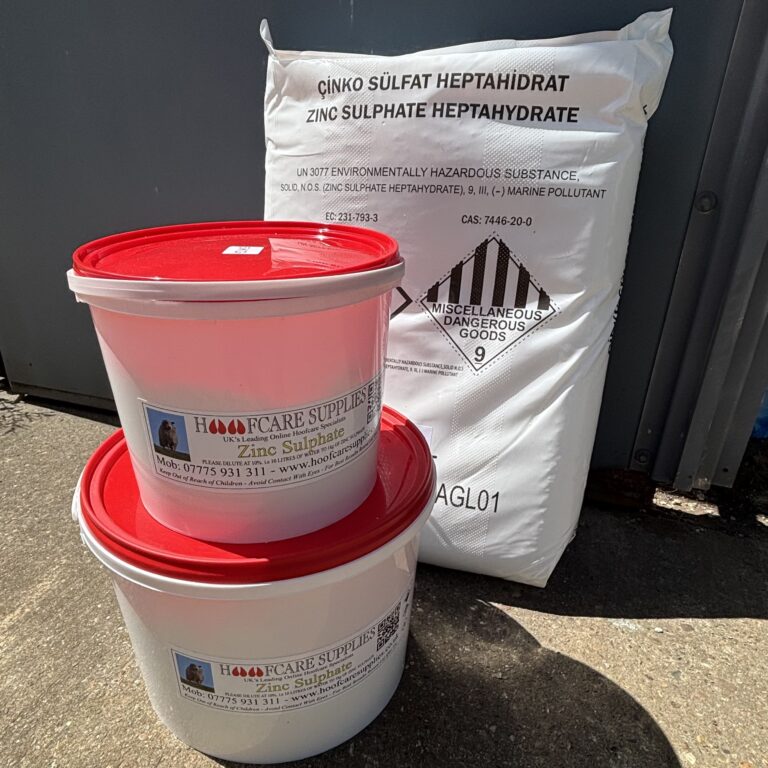
Zinc sulphate is the third active you will see, usually positioned as an alternative or partner to copper — sometimes as a standalone bath, sometimes blended with copper to reduce the copper load. The appeal is a lower environmental profile than copper and none of formalin’s handling and carcinogen concerns.
The honest position is that the evidence base for zinc as a standalone footbath is thinner than for copper or formalin. NADIS lists zinc sulphate at around 10% but notes that supporting evidence is lacking, and research trials have tested a wide 5–20% range without the weight of evidence copper and formalin carry. Zinc sulphate is also less soluble than copper, so it can be harder to get fully into solution. If you are considering a zinc or zinc-blended bath, it is worth confirming the working concentration (NADIS suggests around 10%) and the supporting evidence before switching a whole herd across. As a way to cut copper use while keeping a skin-hardening effect it has a logical place; as a like-for-like replacement for a proven copper bath, the case is less settled.
Proprietary and antibiotic-free blends
Alongside the single actives, there is a growing market of proprietary, antibiotic-free footbath products — commonly built on glutaraldehyde with quaternary ammonium compounds, or on organic acids — sold on the promise of copper-level efficacy without the disposal problem or formalin’s hazards. The independent evidence is genuinely mixed: peer-reviewed trials of commercial glutaraldehyde/quaternary-ammonium products have variously shown a reduction in digital dermatitis and shown no significant difference from an untreated control, so the case rests on the specific product’s data, not the category. Some units find them a genuine step forward; others find the running cost hard to justify against a well-managed copper bath. They are worth evaluating, but on evidence you can attribute, not on the label.
One product to be clear about: salicylic acid is not a footbath agent. It is an individual-lesion treatment — a keratolytic paste applied under a bandage to chronic, proliferative (M4) digital dermatitis lesions — and it belongs on the foot of a specific cow, not in the bath. If you have seen it listed as a footbath option, that is wrong. We cover where it does fit in the digital dermatitis guide.
How to choose for your herd
There is no universal answer, but the trade-offs point fairly clearly once you frame them against your own setup:
- By herd size and throughput. Larger herds put more feet through the bath and refresh more often, so per-fill cost and disposal volume add up quickly — the disposal question and copper build-up matter more the bigger you are. Smaller herds have more room to run copper sulphate simply and change it on schedule.
- By housing and temperature. If you footbath through winter in an unheated yard, formalin’s cold-weather weakness rules it out for much of the season — copper sulphate is the more reliable choice when it is cold.
- By who is doing the mixing. Where the bath is filled by general farm staff in an enclosed space, formalin’s handling and ventilation demands are a strong argument against it. Copper and zinc are far more forgiving to run day to day.
- By environmental constraint. If your land is already at or near its copper loading, or your disposal route is tight, that is the case for looking hard at zinc-based or proprietary alternatives — with the evidence caveat above.
For most UK dairy herds the pragmatic answer remains a well-run copper sulphate bath, with formalin reserved for units that can handle it safely and are not footbathing in the cold, and zinc or proprietary blends considered where copper disposal is the binding constraint.
Footbath design and pass-through: the part that decides everything
Here is the uncomfortable truth: the solution is often not what is holding a herd back — the footbath is. The best chemical in a badly designed or badly managed bath will underperform a modest one run well. Two things matter more than the choice of active.
Foot hygiene going in. A treatment bath sited behind a slurry-covered collecting yard is diluted and fouled within a fraction of the passes it should manage. A pre-wash bath or clean-water bath immediately before the treatment bath extends the working life of the solution enormously and lets the active reach clean skin instead of a layer of muck.
Bath dimensions and refresh discipline. The bath needs to be long enough that each foot is dunked more than once as the cow walks through, and deep enough that the solution reaches the heel and pastern where lesions form. AHDB guidance is a bath at least 3 m long — 3.5 m ensures every foot is dunked at least twice whichever foot the cow leads with — filled to a solution depth of at least 12 cm. And solutions are spent after a set number of cow passes, not a set number of days by eye: NADIS guidance is roughly 100 cow passes per 100 litres of solution, and never leaving a bath more than 48 hours without refreshing. A bath changed on a schedule you can defend on numbers is worth more than any upgrade in chemical.
Get the right footbath products for your herd
Browse copper sulphate in the pack size that suits your bath, or explore the wider hoof treatments range for the products that sit alongside a footbath programme. Not sure which solution fits your housing, herd size and disposal setup? Speak to the Hoofcare team for tailored advice.